Game design document, summarised
How it's designed
Each part below condenses one chapter of the game design document. Every summary ends with a link to
the full chapter in the PDF.
01Overview and pillars
A calm, card-collecting match-3: the reward for a level is a tarot card with art and a line of insight, not just stars. Genre conventions stay (a map, swipe to swap, specials, blockers, move limits) so the game is instantly familiar; the originality goes into the reward, the theme and the tone.
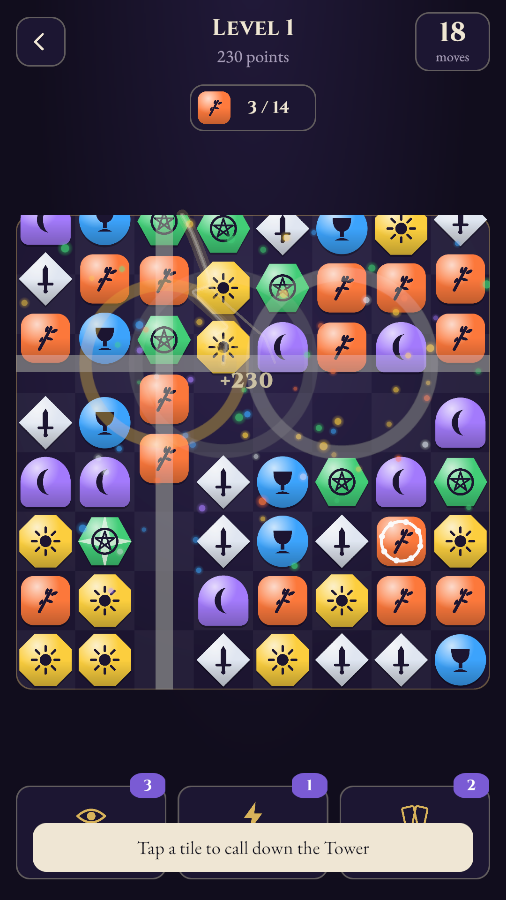
- Readable at a glance: colour, shape and glyph on every tile.
- Every win gives you something to keep.
- Gentle, not punishing: free invalid swaps, automatic reshuffles, no energy system.
Read the full chapter in the GDD (page 2)
02Core and meta loops
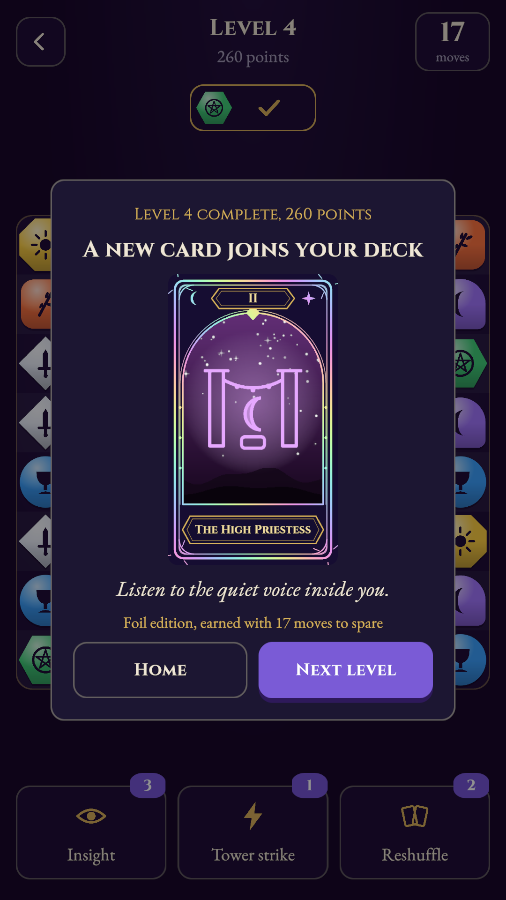
A level is 18 to 24 moves of reading the goals, swapping, and watching matches, cascades and specials fill them. Each win unlocks a card (foil with 5+ moves left), the Fool walks on along the map, and every fourth level is a gate with that chapter's major arcana. At three cards a daily draw opens: one card a day from your own deck, with no streak to lose.
Read the full chapter in the GDD (page 4)
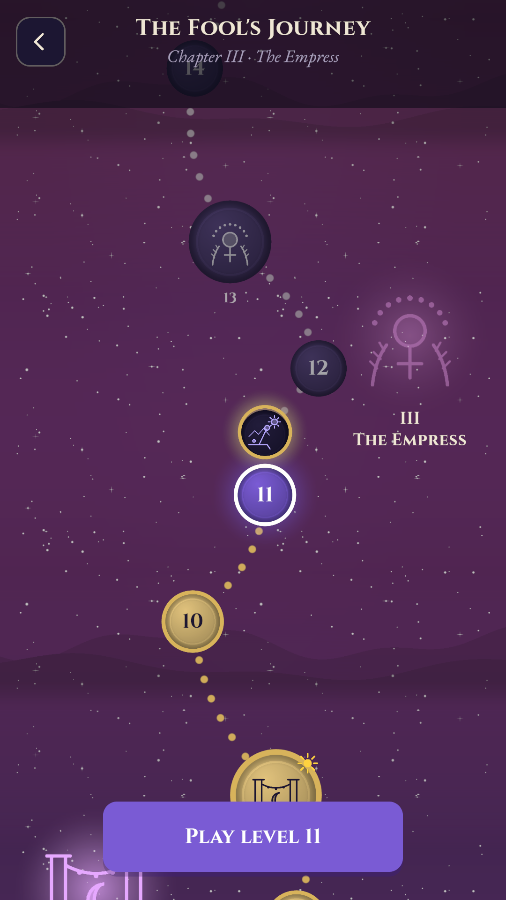
03The Fool's Journey
The levels are the tarot's own story: a prologue, then 21 chapters of three suit levels and a gate. Gates are the difficulty spikes and the next chapter opens with a breather. A fix found in my own spreadsheet: in v1 every Pentacles level was also a major level, so Pentacles cards arrived last; moving majors to chapter gates gives every suit its own card levels.
Read the full chapter in the GDD (page 5)
04The board
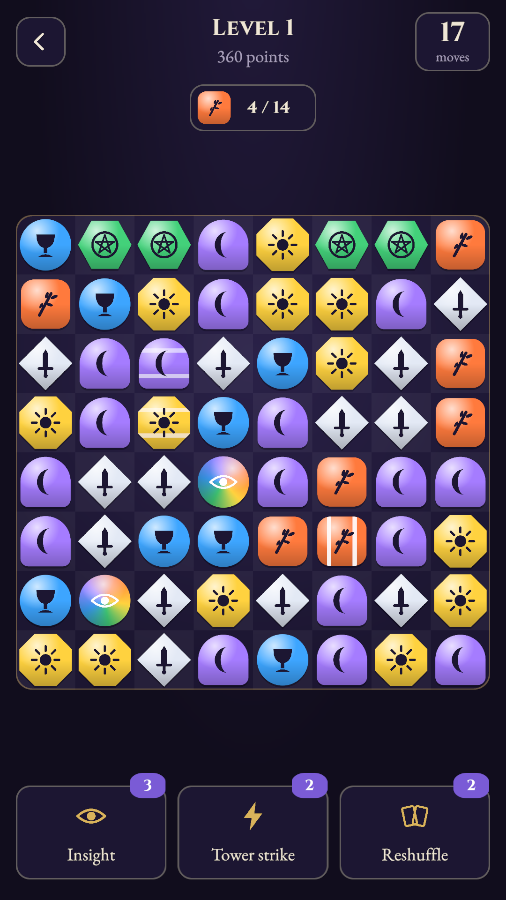
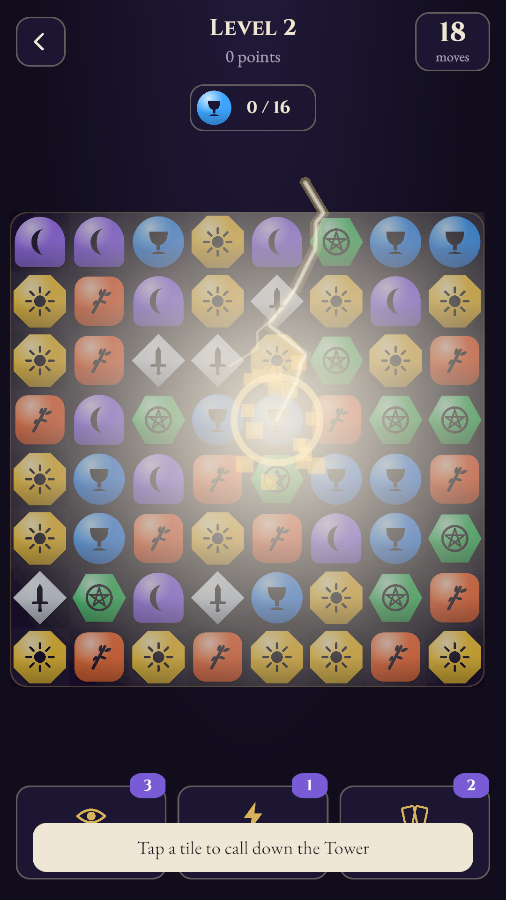
Four suits carry the theme and the goals; Moon and Sun tiles dilute them so only about a third of the board is ever the target. Every edge case resolves in the player's favour: a starting board with no matches and at least one move, invalid swaps that cost nothing, dead boards reshuffled for free, and goal suits 1.4× more likely to drop in so large late goals stay reachable.
Read the full chapter in the GDD (page 6)
05Special tiles and combos
Harder shapes make stronger tiles: a square makes a Wheel, a line of four a row or column clearer, an L or T a Star, a line of five an Arcana tile. A special made by the player's swap lands where they swapped, so it can be aimed. Swapping two specials combines them into crosses, big wheels, starbursts and Arcana infusions, a second layer of planning for skilled players. Squares and L/T shapes were added after the prototype showed specials were rare and always the same two.
Read the full chapter in the GDD (page 7)
06Blockers and board shapes
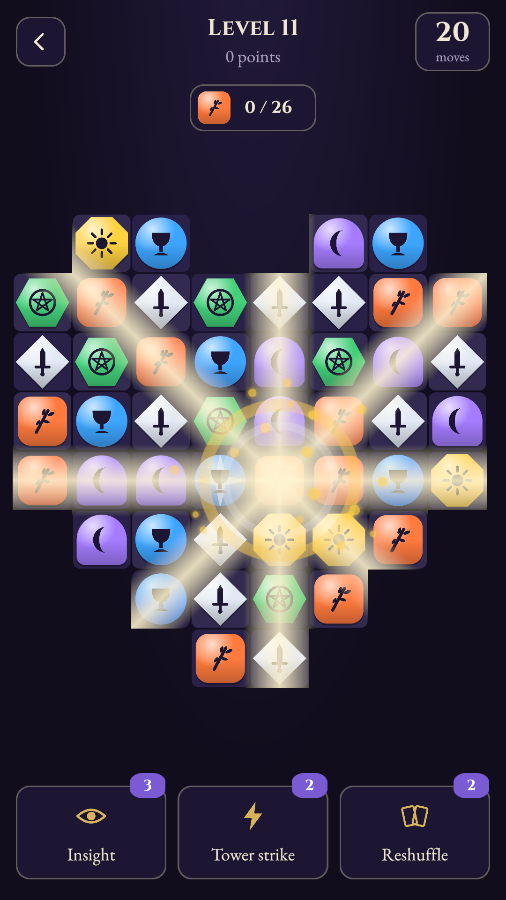
From level 5 the board takes one of 11 shapes (Arch, Pond, Heart, Four Wells…); eleven, not twelve, so every shape lands on a gate at some point. Three blockers, each themed to its gate's card: Veils (the High Priestess's curtain), Shackles (the Hierophant's old rules) and Stone Seals. Gravity slides tiles diagonally around holes, and a test deals and plays every level of the journey.
Read the full chapter in the GDD (page 9)
07Levels and balancing
85 levels come from a few rules: goals grow by two tiles a level, moves by one every three, scaled by the board's size, with gates as spikes. A bot plays the shipped rules on every level. A spawn-weight sweep chose 1.4× for goal suits (level 18 from 33% to 85% wins), and fixes for holey shapes and blocker gates lifted every gate to 68–100%. A random bot wins only 25% of levels after 40, so thinking matters.
Read the full chapter in the GDD (page 10)
08Boosters, winning and losing
Three boosters, none costing a move: Insight shows a valid move, Tower Strike clears a 3×3 (armed first, so a stray tap isn't wasted), Reshuffle deals a fresh board. A win is checked before a loss, the lose screen says exactly what was missing, and five extra moves are offered once per attempt.
Read the full chapter in the GDD (page 12)
09The collection and the daily draw
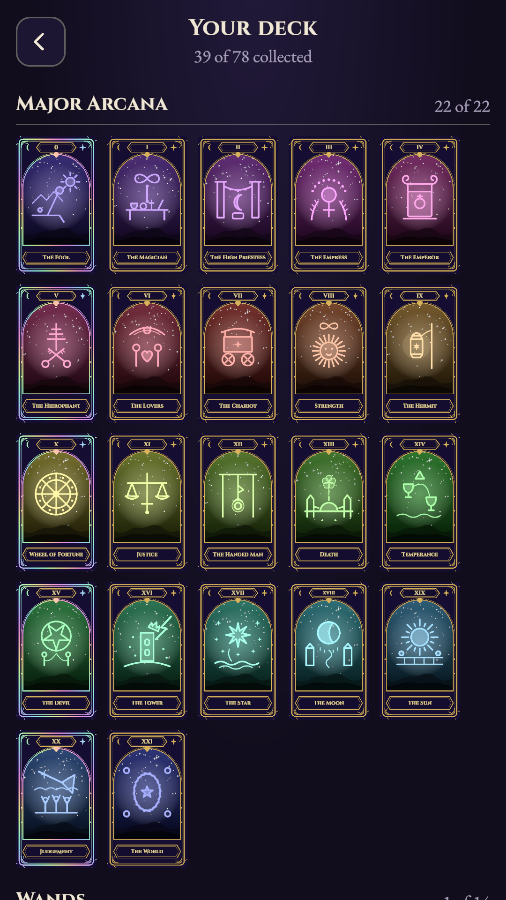
All 78 cards (22 major arcana, 56 minor), each with original art composed at runtime from shared layers and a one-line insight. Gates award that chapter's major in order; suit levels give a random missing card of their suit. Random draws within each pool replaced a fixed order that made every deck look the same.
Read the full chapter in the GDD (page 13)
10Story: Pip, the Fool's dog
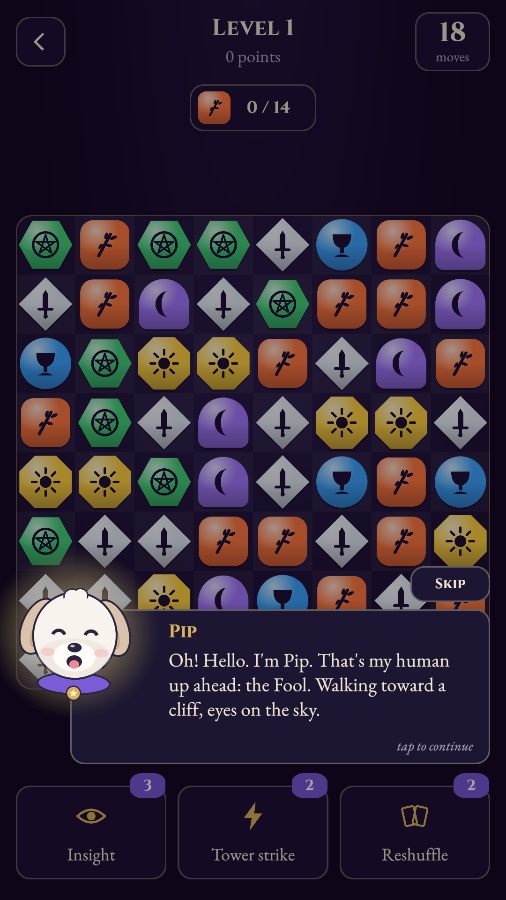
The little white dog from the Fool card tells the journey: loyal, excitable, a bit cheeky, and the only one who notices the cliff. 21 chapter openings, 21 gate scenes that introduce each blocker in the card's own terms, and four just-in-time tips, all in one plain text file a writer can edit, with five moods for his face.
Read the full chapter in the GDD (page 14)
11Economy, UX, art and audio
Monetisation is designed as optional time-savers: no energy, no card can be bought, ads only opt-in and rewarded. The art is a tarot deck read by candlelight (night sky, antique gold, jewel-bright tiles), Cinzel and EB Garamond type, and every sound is synthesized: glass bells that climb a pentatonic scale with each cascade, and two music moods that crossfade.
Read the full chapter in the GDD (page 15)
12Technology, playtesting and roadmap
Rules in plain C#, animation as playback: a move resolves instantly into ordered steps that the view animates, so the view can never disagree with the rules. 153 EditMode tests cover every rule and the whole journey. Seven checkpointed phases, each playtested; the table of what testing changed, a plan for the next round, and soft-launch KPIs close the document.
Read the full chapter in the GDD (page 20)