Game design document, summarised
How it's designed
Each part below condenses one chapter of the game design document. Every summary ends with a link to
the full chapter in the PDF.
01One chain, four kinds of fun
Each stage spends what the last one earned: board → power → paint → painting → gallery. A level is about two minutes: a 30-second charge, one continuous camera turn, a minute of climbing and a guardian at the top; every third level is a restoration.
- One currency per step: a lazy charge is felt on the climb, a timid climb in the restoration.
- The board decides how bold you can be: a strong charge opens the rich lane.
- An ad that is the game: every ad frame is captured from the build.
Read the full chapter in the GDD (page 2)
02Stage 1: the charge
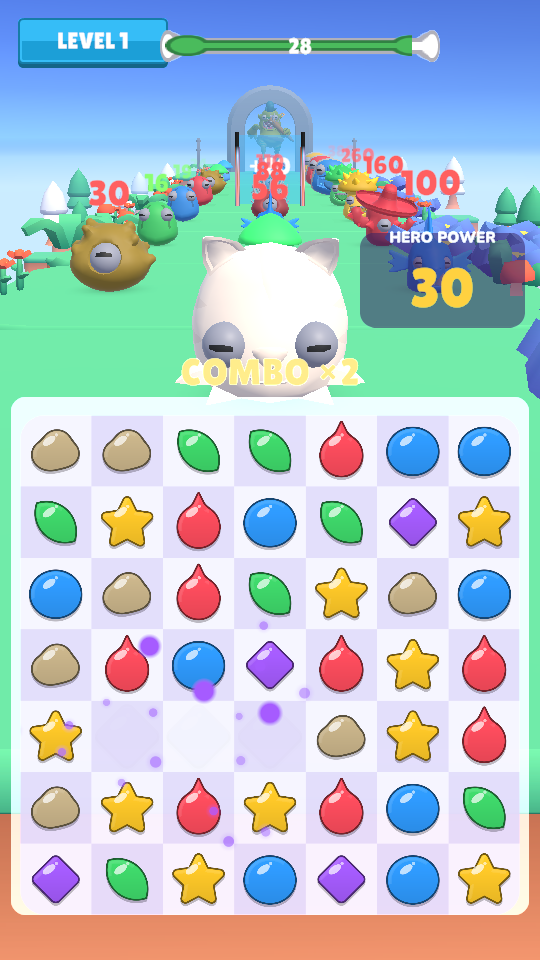
Thirty seconds on a 7×7 board of six tiles: five paints and a clump of grey sand. Power starts at 10 and grows by 1.1 a tile and 8 a special; a special-plus-special combo multiplies the whole charge by 1.4. A star special gives a shield, a colour bomb a magnet with three pulls.
Tuned twice: a fast bot first reached about 200 power against climbs built for 50–140, and a playtest found the board too generous (73% of moves cascaded). A sixth tile and a refill that avoids ready-made lines brought cascades to 42%, with medians of 52 / 98 / 122 power for weak, average and strong players.
Read the full chapter in the GDD (page 3)
03Stage 2: the climb
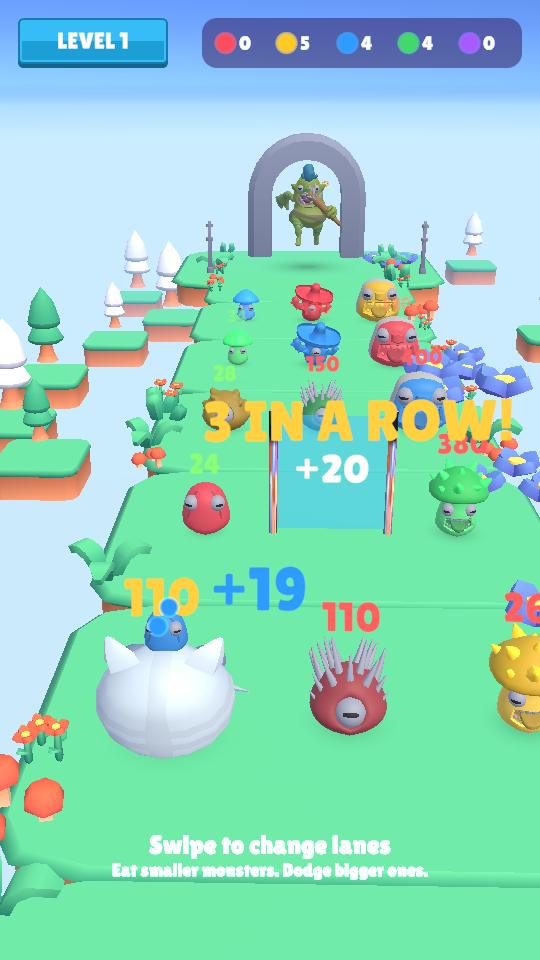
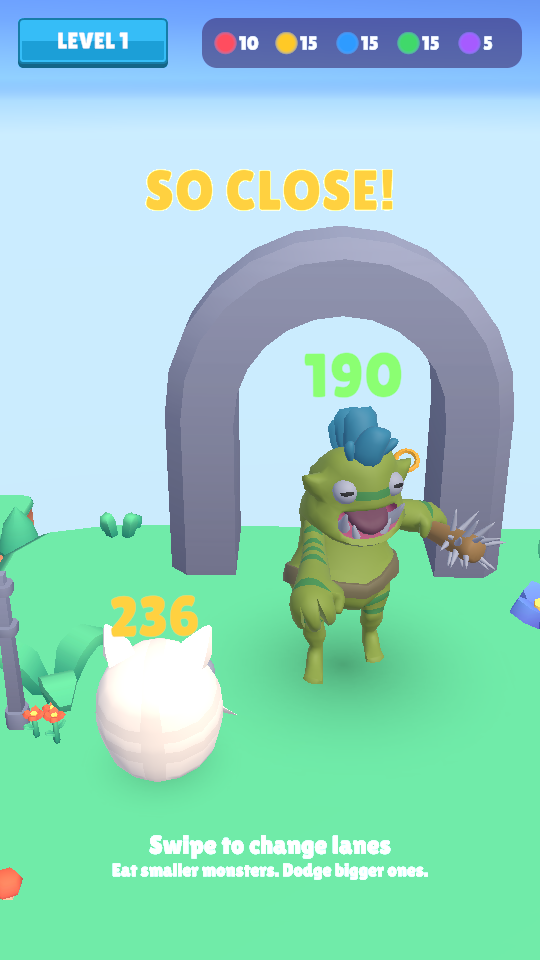
The hero walks up three lanes. Smaller monsters are eaten and drop √power paint in their colour; bigger ones eat the hero unless a shield takes the hit; glass gates add, multiply or subtract; the guardian at the arch pays a jackpot. Every row offers a safe snack, a rich meal and a danger, one lane step apart.
Guardians are set by a careful weak player's route, not the perfect one. Weak players win 33–90% of normal climbs, average players 80–97%. A playtest caught the magnet eating both side lanes on every row; it now has three pulls. A meal adds at most 30% of the hero's power, so a strong hero meets the guardian with about 6 times its power, not 22.
Read the full chapter in the GDD (page 4)
04Stage 3: the restoration
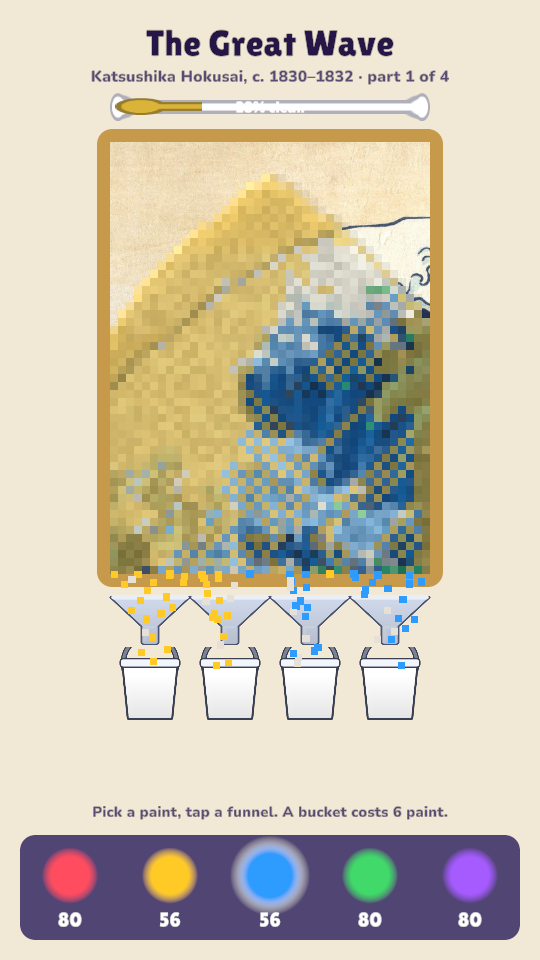
A quarter of a painting turned into 40×54 grains of sand. A bucket placed under one of four funnels drains its paint (and the dust) out of the picture; the sand above slumps into the gaps. Buckets cost 6, 10 and 15 paint by chapter, early swaps refund their unused share, and 80% drained wins: a brush sweeps the rest away.
Redesigned after the first playable: sand bands with stone plugs read as a sorting puzzle unrelated to the art. The painting itself as sand is the version that shipped, and the reason to collect. Then a playtest found it janky: the brushwork came out as speckle, and each bucket caught a few grains before one of another paint jammed it. The sand is now smoothed into patches and a bucket reaches four rows up: 24 buckets a quarter at about 74 grains each, down from 142 at about 14.
Read the full chapter in the GDD (page 5)
05Chapters, the finale and the gallery
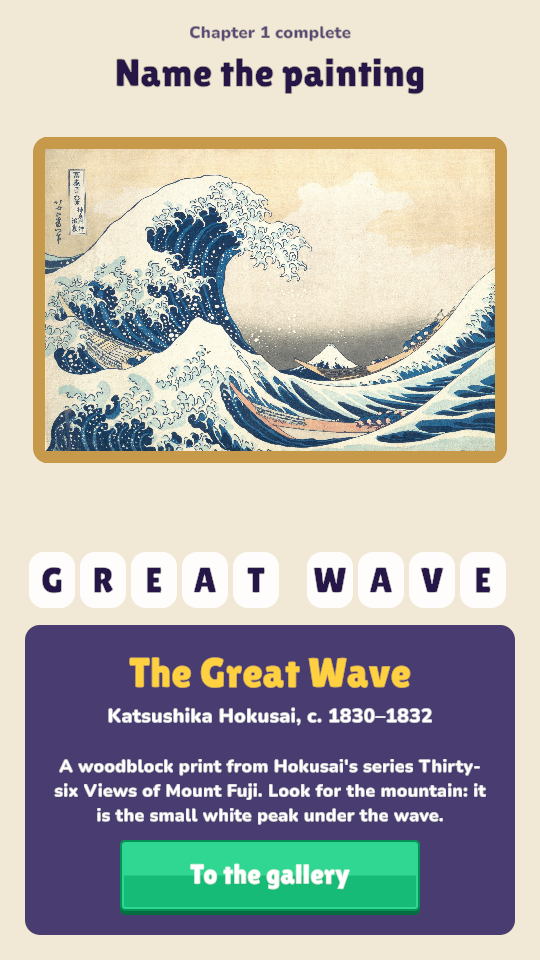
Three chapters, one public-domain masterpiece each: Hokusai's The Great Wave, Van Gogh's Wheat Field with Cypresses and Vermeer's The Milkmaid. A chapter is 12 levels (two of them hard climbs) and a finale where the player spells the painting's name from letter tiles. The finale can't be failed: it's the payoff, not a gate. Then the painting hangs in a gilt frame in the gallery.
Read the full chapter in the GDD (page 6)
06The meta: daily, Grand Climb, skins
- Daily painting: one quarter a day, the same for everyone, restored from its own box of buckets (what the bot needs ×1.3 plus a spare). A streak pays buckets for your next restoration.
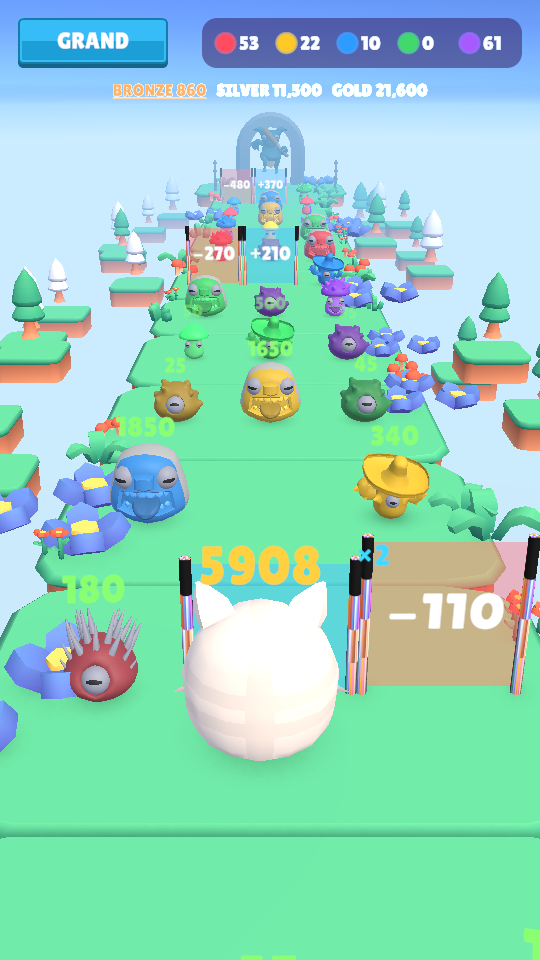
- Weekend Grand Climb: a generated 20-row climb with bronze, silver and gold lines; weak players reach bronze about 90% of the time, average players split silver and gold.
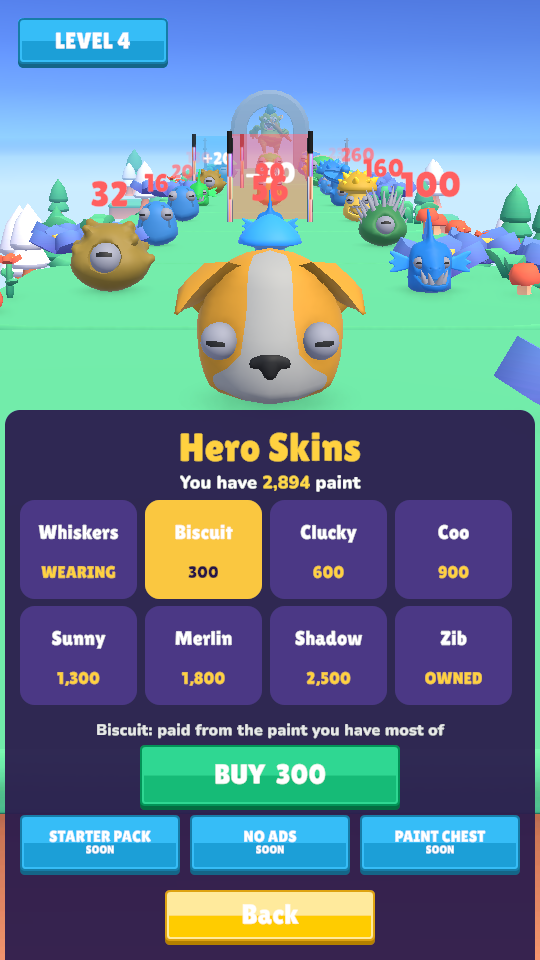
- Skins: eight heroes from 300 to 2,500 paint, paid from your biggest piles: the sink for off-colour paint.
Read the full chapter in the GDD (page 7)
07Economy and balance
Bots play whole chapters, replaying lost climbs and climbing again when short of paint. Before tuning, a bucket cost 5 everywhere and climbs paid 5–10 times what restorations needed, yet a weak player was nine climbs short in chapter 2: the paint came in the wrong colours.
Three changes fixed it: each chapter's monsters drop the colours its painting needs, bucket prices rise by chapter, and a restoration keeps the sand already drained. Now weak players need 0.8–1.5 extra climbs a chapter and average players at most 0.3.
Read the full chapter in the GDD (page 8)
08Ads the player chooses
Rewarded ads are optional and capped at 12 a day: a revive, double paint, a refill of the paint a painting needs most, and extra Grand Climb tries. Interstitials only appear after a won climb from level 8, at most every third climb and three minutes apart, and never for paying players. A starter pack, ad removal and a paint chest are the purchases. All of it goes through IStoreService and IAdService, with the rules unit-tested in pure C#.
Read the full chapter in the GDD (page 9)
09Art, audio and feel
The genre's look, readable at a glance: a floating grass track, chunky low-poly monsters, huge outlined numbers (green if you can eat it, red if it eats you), glass gates. The five paints are the same five colours on tiles, monsters, counters and buckets, and every tile has its own shape for colour-blind players. Bites chomp higher with every row in a row, near-wins slow time, and every sound and both music loops are synthesized in the editor.
Read the full chapter in the GDD (page 10)
10UX and onboarding
Level 1 teaches itself; one new idea arrives at a time (minus gates on level 3, the first restoration on level 3, the first hard climb on level 5), and the meta opens only after the first restoration. Nothing is lost for good. Targets for the first session: level 1 in under two minutes, the first restoration by minute 6, the first painting named by about minute 30.
Read the full chapter in the GDD (page 11)
11Technology, process and roadmap
Every rule lives in pure C# with no UnityEngine, covered by 136 EditMode tests; 6 PlayMode tests play the real scene with bots. The same core compiles into a console simulator that plays thousands of charges, climbs, restorations and whole chapters. Eight phases, each a playable checkpoint; I designed and directed, an AI coding assistant (Claude) wrote most of the code to my specs.
Read the full chapter in the GDD (page 12)