Game design document, summarised
How it's designed
Each part below condenses one chapter of the game design document. Every summary ends with a link to
the full chapter in the PDF.
01The game in one screen
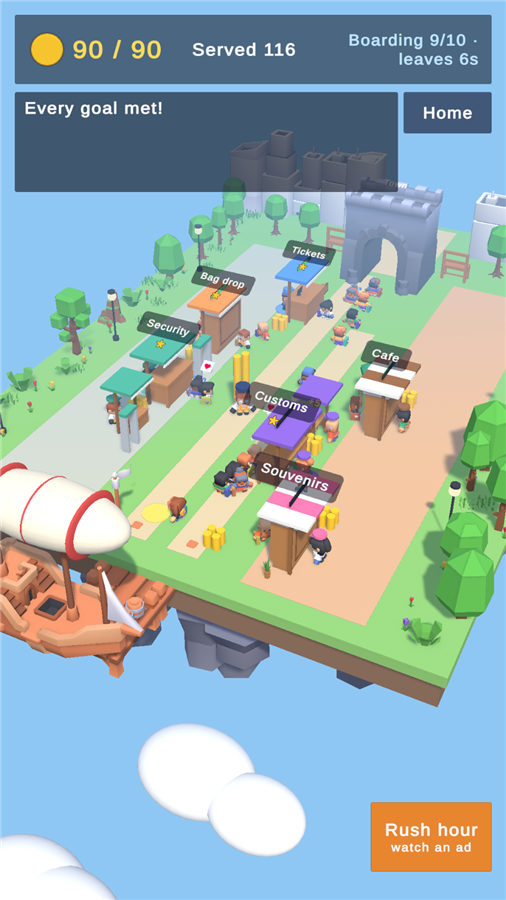
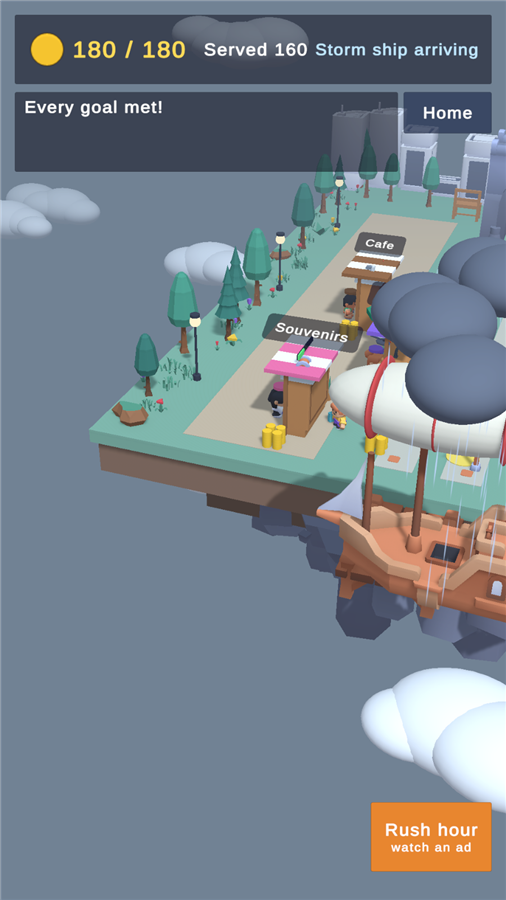
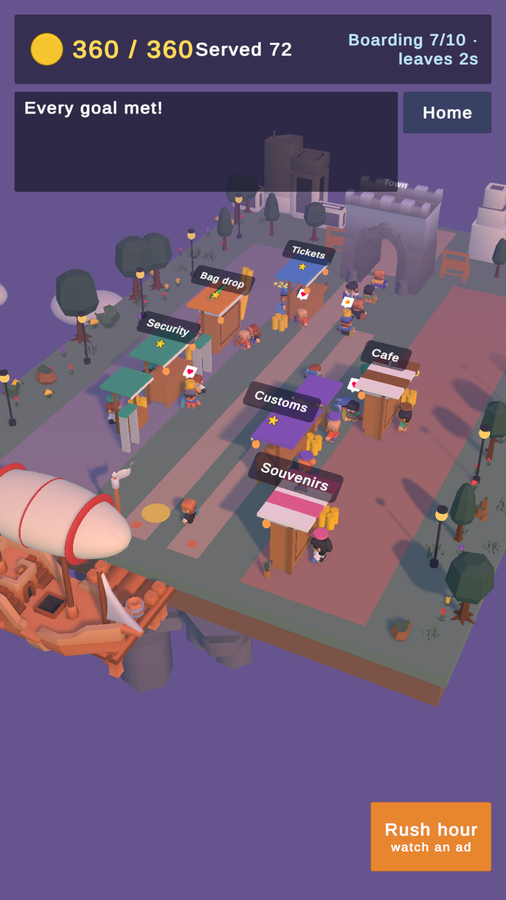
A floating island seen from above: airships dock at the south end, the town gate is at the north, and in between runs a chain of counters the player builds, staffs and upgrades.
- Walking is routing: the player's time is the scarce resource; no chores exist only to add friction.
- Always something to buy: a new pad every one to five minutes.
- Ads are opt-in boosts: no upgrade sits behind an ad.
Read the full chapter in the GDD (page 2)
02Core loop: serve, pick up, spend
Stand behind a counter and a bar fills; the fare lands as coins (a traveller served by the harbourmaster himself tips 50%). Walk over the pile and the coins arc onto the stack on his back; stand on a pad and they pour in until the counter, clerk or zone appears. Staff work at 45% of his pace, so hiring frees him but never replaces him. The café and souvenir stall pay most: the first coins that arrive without him.
Read the full chapter in the GDD (page 3)
03The island: three zones, 22 pads
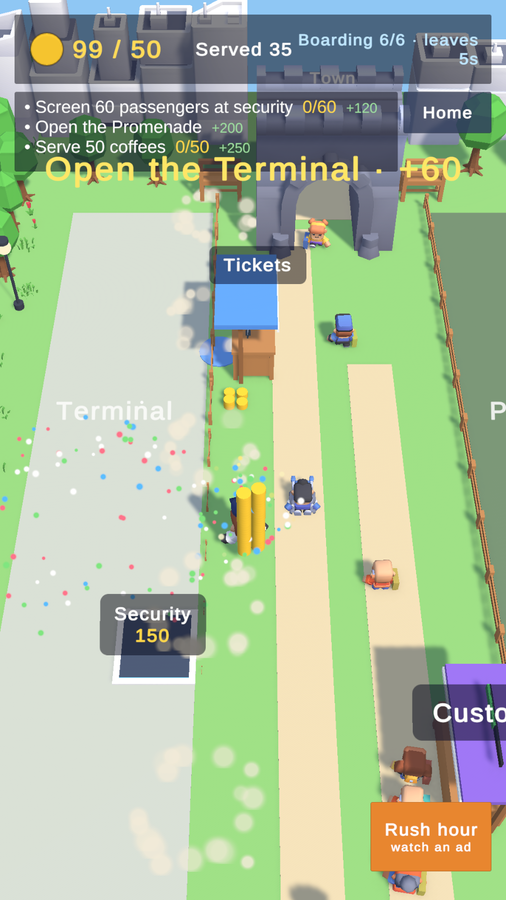
The Harbour is open from the start; the Terminal (about 4 minutes in) and the Promenade (about 29) are fenced, shaded and named, so the next goal is always in view. Each pad appears when the one before it is bought. Four kinds of pad: demand and staff pay back in 5 to 17 minutes; capacity keeps queues short as demand grows; new counters open the next purchases.
Read the full chapter in the GDD (page 4)
04Travellers: queues you can read
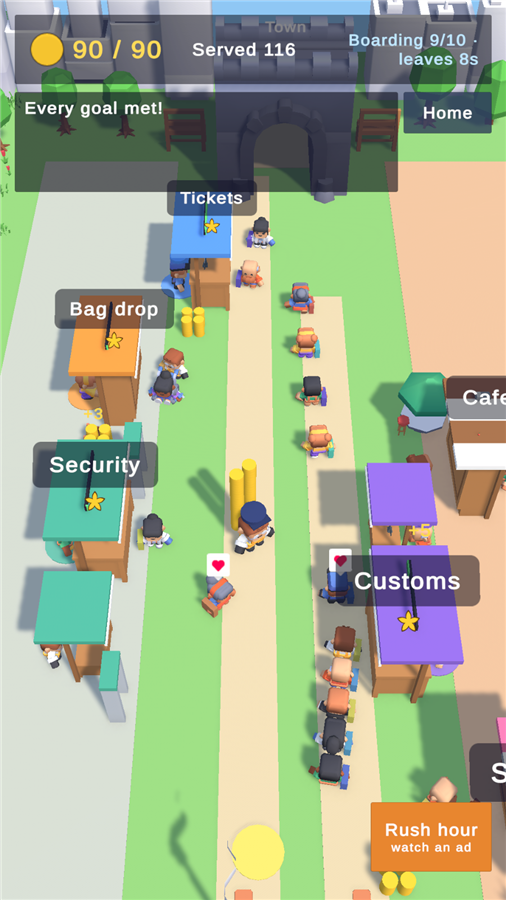
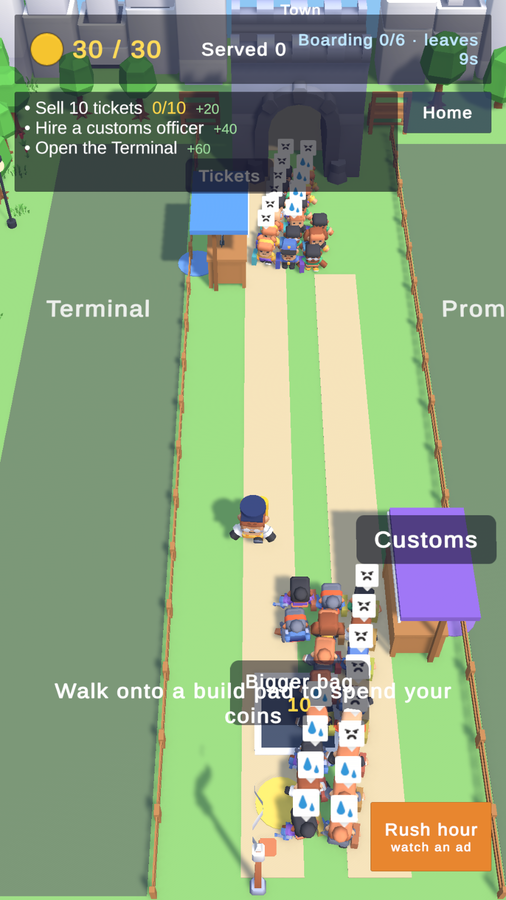
Arrivals clear customs to the town; departures pass tickets, bag drop and security, may stop at the shops, and board. After 40 seconds in queues a traveller turns grumpy, pays half and skips the shops. Moods show as speech bubbles (angry, a heart, sweat drops, a VIP star), so a failing counter is readable from across the island.
Read the full chapter in the GDD (page 5)
05The timetable: supply is the pacing lever
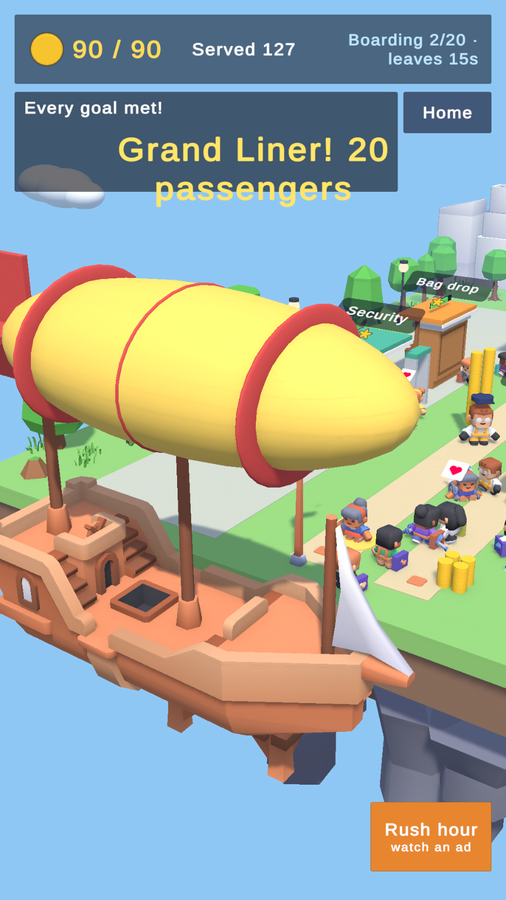
Income is capped by how many travellers the airships bring, so the timetable, not the counters, decides how fast an island can grow. A ship every 40 seconds; bigger airships and more flights raise demand with purchases, not with time; every fifth ship is a Grand Liner with twice the travellers and its own music; storms on Galewind bunch the crowds.
Read the full chapter in the GDD (page 6)
06Economy and balance: bots play the real rules
The simulator plays each island 40 times with a new player, a casual and an expert. The tuning story: everyone first finished in 15 minutes because skill didn't matter; demand upgrades and rising prices made it 52 minutes; slower staff made the harbourmaster matter but 46% of travellers turned grumpy; capacity to match demand brought that back to 10%. A hands-on player now finishes about six minutes sooner than a new one.
Read the full chapter in the GDD (page 7)
07Campaign and meta
Three islands with the same 22 pads and 10 goals but a new twist each: Cloudhaven teaches the ropes, Galewind brings storms, Lantern Reach brings VIPs who pay triple with half the patience. Prices scale with each island's multiplier, so a ×4 island isn't four times longer. Staffed islands earn while you're away (capped at two hours, doubled by an optional ad), and a daily event adds a bonus.
Read the full chapter in the GDD (page 8)
08Art, audio and feel
Chunky pastel low-poly from six CC0 Kenney kits, with a palette, light, fog and music for each island. Every action is animated: coins arc onto the stack with a rising clink, the stack leans as he walks, new counters land with a bounce and dust, and a zone opens post by post with confetti and a jingle.
Read the full chapter in the GDD (page 9)
09UX: teach by doing
Three hints, then silence. Goals come three at a time with rewards that land in the bag; a floating joystick works anywhere; signs on plates name every counter and price. The home screen shows the island playing itself behind a translucent menu.
Read the full chapter in the GDD (page 10)
10Technology and roadmap
Every rule is in a pure C# core that ticks at 60 Hz and runs both in the game and in the economy simulator, with 32 EditMode tests. Next: playtest the minutes 5–15 plateau, a fourth island and a helper booster, cosmetic airships, and a soft launch with the KPI plan.
Read the full chapter in the GDD (page 11)